Sunday, January 29, 2012

The IT Crowd?

(This article was originally published in Entelechy, edition 32, Jan 2012. It is being published here in full with some annotations.)

It has continued to surprise me over the last 3.5 years how few information technology students actually bother to use the innovations of information technology to improve their productivity in any manner. More importantly, they are usually unaware of the products themselves. Recently the issue was brought to the fore when Skish Champi pointed out that Zimbra Collaboration Suite had great calendar integration (and I agree), and we as a college are still struggling around with sending meeting emails and reminders.

We are all experts at using DC++ to share files over our network. Yet, when it comes to sending the same files over the Internet you still stick to (gasp) e-mail. If you send me a 50Mb file over email in 2012, I’m going to knock on your door with a gun in my hand. Use Dropbox or a thousand other such services. You only need to upload once, your multiple devices can continuously sync the files, individual folders can be shared with individual people — this is great for working on projects and such. In addition Dropbox keeps old versions around. Heck, using the Public folder you can even host a complete static website without paying a paisa! Once your file is on Dropbox you can go trigger happy with the public link and send the link in the e-mail instead. Less load for the e-mail servers, and the link can easily be shared via any other medium too.

Similarly, if you are in charge of planning a lot of events (looks at the committees and clubs and faculty), create a new Calendar event in Zimbra and send it to all batches. That way a student simply has to accept the invitation, and he will also occasionally get reminders. Synced with a desktop Calendar application, you can even have your computer play sounds or show messages even when webmail is not open. Now you have no reason to forget or be late for a meeting.

If you are working on a software project, and your way to ‘work as a team’ on the code is to ship around newer versions of the files to everyone via e-mail, your project is already dead. Why? What happens when you suddenly need an older version? Or one feature from Amrita and the other one from Rajni? Spend your time copy-pasting? Let a version control system do it for you!

I’m going to mangle The Unix Philosophy slightly to suit my purposes:

  • Use software that does one thing, and does it well.
  • Use software that does not lock your data in, or modify it so no other software can use it. A hyperlink should always be available.
  • A software which allows its output to be the input for another program, is usually better than one that doesn’t. An API can do wonders.
  • Understand your work flow. Don’t hesitate to throw away the clumsy parts.
  • Use tools in preference to manual labour, even if you have to detour to build the tools.

So why do we continue to use legacy technology, mouse around and generally not maximise our use of the computer?

One reason is of course inertia. Our biological brains are always trying to survive and if one thing works we aren’t willing to go improve. Another is a lack of curiosity about wanting to hear about new technology.

But it is also an attitude problem. Technology continues to be the poor step-daughter. If someone shows you how to skin potatoes faster, you’ll quickly adopt the technique. But as soon as the metaphor moves onto the computer, there is immediate unwillingness. From the very beginning of our computer education we’re asked to treat the computer as some magic box, and restricted from doing anything outside of that ‘education’. “Usse haat mat lagana nahi to kharab ho jayega.” is what your parents/teacher says. (English: Don’t touch that, you’ll break it). We carry over this belief that computers are frail creatures even when we become more responsible. The second reason is that the internals of computers continue to be treated as unknowns for much of the population. Most people who drive a car have a qualitative idea of how an internal combustion engine works. They also know how to change a tire. But the same people don’t know how to add RAM or the basics of a processor. Worldwide, computer literacy focuses on office suites and the like. Even when you do eventually study the internals, they remains something from the textbook, so that whenever your C program is malfunctioning you don’t once bother to think in terms of how that program is being interpreted in a certain way, and how that can help solve the problem. This disconnect is alarming, I’ve seen computer science professors being unaware of basic computer features. The funniest example I can think of this is when Windows users keep right clicking on the desktop and hitting Refresh when things aren’t moving.

The media is also responsible. World news is quick to highlight the policies and laws that will affect say, retail, or corruption or some industry. Technology media however is focused on product reviews and the next revolutionary technology (which is usually some old concept re-hashed), and sidelines actual problems which will impact privacy, ownership and other fundamental rights in the digital age, so that the notion of computing in itself is never given enough attention by the general public. If car manufacturers specified which brand of fuel you could use in their cars, there would be a hue and cry over anti-competitive behaviour and not giving choice to people. Yet mobile phone carriers fleece people every day with locked, underpowered cell phones. The war on computation keeps going the wrong way.

I also believe, that just as in mathematics, computers require significantly more complex mental models to be manipulated in the mind. A car engine is heat and metal and chemicals and can directly be observed doing something. The levels of abstraction between the electrons racing through the wires and the point and click metaphor of daily interaction are numerous in comparison. As a user you do not of course need to have any inkling of them, but even at the software layer, a computer desktop is much more congested and much less tangible. Most normal people seem to keep missing subtle user interface clues that convey meaning. To those with the mental ability to hold these models and think rationally and logically (the only way in which the computer can think), the paradigms are much clearer.

But as ICT students you are expected to have that mental ability. The first thing to do is to lose fear of the computer. Modern operating systems and applications are robust enough so that they won’t go down just due to clicking in the wrong place. Experiment with preferences, try buttons which have only icons, many a feature can be discovered this way. Second, internalise the knowledge as much as you can by always trying out new things yourself, until they become second nature. Third, think through what you are doing rather than just clicking as your friend told you to. Fourth, remember that like in all engineering disciplines, convention is implicitly followed in computing as well. So concepts you learn in one application (say drag and drop) can be generalized and applied everywhere. Fifth, start thinking of computing tasks as recipes. In cooking, you apply a series of tools, to transform various inputs (ingredients) to the final outcome. The output of the knife becomes the input of the frying pan. On the other hand, most software normal people use tends to be monolithic, one tool that will do all the steps. Good software on the other hand has separate knives and separate frying pans and allows a great deal of flexibility. The Unix command line is the most pervasive and powerful example. Sixth, keep your eyes open for new ways of better using technology. Blogs like lifehacker are an excellent source of such tips. Seventh, pay attention when governments and companies try to cripple your right to compute and the right to information.

With a little active effort, you streamline your computing experience, so that you can devote complete attention to the fantastic things you create.

Posted via email from nikhil's posterous

Monday, January 09, 2012

Toggling Proxy settings quickly with Pentadactyl and Firefox

If you use the excellent Pentadactyl plugin for Firefox to get vim super-powers to the browser, here is a quick and painless way to toggle between a direct connection to the internet or using the default proxy settings. Add this to your ~/.pentadactylrc
command proxy -nargs=1 :set! network.proxy.type=<args>
nmap up :proxy 1<CR>
nmap np :proxy 0<CR>
Now pressing up (Use Proxy) will enable Manual Proxy Settings while pressing np (No Proxy) will use Direct Connection. network.proxy.type can take other values which might be suited to your setup. You can change the key bindings too.

Thursday, December 22, 2011

Tic-Tac-Toe with Redis and Backbone.js

This post is a technical overview of my Tic-Tac-Toe implementation. It is a zero server-side logic, pub-sub based, realtime, multiplayer game which uses Redis and Backbone as the key enablers of real-time and moving logic to the client side, respectively. Now that all the buzz-words are out of the way, the source code is on Github. There are rough edges with reliable communication, security holes do exist, but for the most part it works well.
I would specially like to thank Nicolas Favre-Félix for Webdis without which this would’ve been impossible.

Basic functioning

On visiting the home page the user has an option to either join a game, or play with a friend. The join game option pairs the player with another player who also wants to play (if you are the only one online, you’ll have to wait). If you play with a friend you get a link you can send him/her so you can play together.
The players are asymmetric in the sense that there is a ‘hoster’ and a ‘joiner’, whose roles I’ll get into in a bit.

Technology Stack

Tic-Tac-Toe game me the opportunity to experiment with a ton of technologies/products I hadn’t handled before. The stack goes like this.
  • A Linode VM hosts the service
  • Redis powers base Pub/Sub
  • Webdis provides a REST API to Redis so that the clients can directly talk to it
  • nginx serves static files
  • haproxy routes requests to nginx or Webdis depending on the path
  • Backbone is used for MVC
  • Raphaël is used to draw the grid and pieces using SVG
  • jQuery is used for AJAX and the impromptu is used for modal dialogs
  • underscore is a utility belt
  • UUID.js for generating UUIDs
Yep, thats a lot of stuff for something so simple, so I’ve tried to rationalize it below :P

Clients

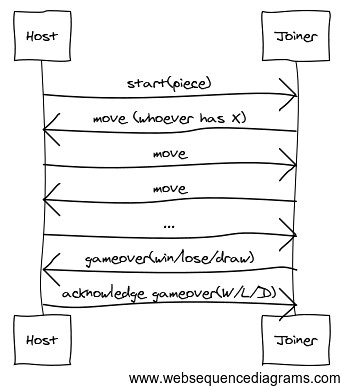
All clients are identified by a UUID. The ‘host’ player’s UUID is used as the name of the Redis Pub/Sub channel. The ‘joiner’ will also subscribe to this channel and publish to it. This is why the ‘host’, ‘join’ bifurcation, so that a common channel can be used for communication. All messages are JSON objects.
All communication is initiated by the ‘joiner’. The host player keeps waiting. The joiner starts the game, after which both players keep sending each other the moves made by the humans playing. After each move, both sides check for a win/lose/draw. Again, the joiner sends a gameover message when it detects somebody has won (or it’s a draw). The host then verifies that this is actually true, and responds back with it’s own gameover message. Then both parties change their UI accordingly. This causes the slight delay between the actual win and the notification.
WSD for Tic-Tac-Toe

Server side

The first question is ‘why both nginx and haproxy?’ I could’ve run Webdis and nginx on two different ports since Webdis supports CORS, but Opera does not support it. Running just nginx web-facing and then proxying to Webdis based on path is also not possible since nginx does not currently support HTTP chunked replies, while haproxy does. Chunked replies are used by Webdis to relay Pub/Sub messages.

Implementing ‘Join Game’

To allow two people to be paired, a Redis list is maintained. When a client clicks Join Game it attempts to LPOP a UUID off the list. If none are found (no other players), it RPUSHes itself onto the list.

Client side

The client side has all the logic and so is more interesting. I won’t go deep (you can read the source), but will discuss the key areas.
Once a game has been initiated, both clients open a XMLHttpRequest to the subscriber channel. They watch for readystatechange events and try to parse the messages. This is the Subscriber which fires events when it receives valid messages.
The Publisher component is used to send messages, while Webdis is used for other Redis commands (currently only LPOP and RPUSH).
The GameRouter is the controller, sets up models and views, watches for gameover and beginning a host or join. HTML5 pushState or hashes are used to offer permalinks for games. /host/UUID is for hosting and /play/UUID is the joiner. Backbone’s Router and History is used to cleanly handle this. One feature I wish there was, is a way to query what the current route is via Backbone instead of mucking with window.location.
The GridModel drives the game once it begins, triggering gameover events and checking the grid after every move, also handling the turns. GridView handles rendering the SVG grid and pieces based on GridModel and processes clicks while HUDView notifies the user of his turn, piece and game state. Events are an integral part of this entire setup and Backbone makes it very simple and modularized.
One thing that stands out in my use of Backbone is the absence of Sync. I’ve not used it, although it integrates well with Backbone. The game model didn’t seem suited to it, being more event-based rather than the model reflecting the game state. Collection is also not used since there is only one grid.

Issues

The lack of any server side code does lead to certain issues. None of them are serious when it comes to Tic-Tac-Toe but some affect the user experience and others are security issues.

Usability

On the usability front, the current code is very fickle. The joiner only tries to initiate the connection the first time it starts. If the host fails to respond for some reason (e.g. network connectivity) then both parties will keep waiting. If a joiner refreshes his page mid-way through a game, the game will restart for both parties (a good idea if you are a joiner and you are losing \:P). If the host refreshes the page, the joiner has to refresh after him.
The slight lag to decide win/lose/draw was probably unnecessary. Rather than verifying both sides are on the same page, the notification could’ve been shown directly since this is just a game. The UX would’ve benefited.

Security

Webdis sports a HTTP interface to Redis, but there is no real authentication support, which means the Redis instance hosting Tic-Tac-Toe is also effectively a public domain database (although the command set is restricted). Ideally this should run only in a trusted intranet. Ideally Webdis itself would be capable of serving files and deliver something like a nonce which it would then use to ensure that only its own connections are allowed to relay messages. Similarly nothing is stopping someone from grabbing the UUID and then playing future moves using a bot of some kind to always play optimally. In the case of Tic-Tac-Toe this is just a minor prick, but for actual client-side MVC applications this requires fixing.

Conclusion

Tic-Tac-Toe demonstrates that with a data structure server and HTTP interface to it, web applications where all logic is client-side are possible. Using the server as a Pub/Sub relay also allows near real-time performance, with WebSockets or SPDY possibly leading to better performance. Security policies still mean that true peer-to-peer isn’t possible. Authenticity and authorization also remain to be solved. On trusted intranets, such applications could be used for non-critical tasks. Meanwhile, games like this at least can be safely implemented and played as long as you have no sore losers :).

Tuesday, December 13, 2011

Why Indian students should attend college

In recent months, the number of posts extolling dropping out of college, or of people recounting their experiences (mostly positive, probably because the negatives won’t share) has increased substantially on Hacker News (I believe Steve Jobs effects on humanity extend here too). Meanwhile the The Story of Average Indian ‘Techie’, What’s your GPA? and other posts bring to the fore some things I do agree with:

  • Most computer science curricula are outdated or just poor quality
  • The majority of students are in it for the money
  • The professors are almost always bad

In fact I didn’t particularly like most of my CS courses either. There were a few gems like System Software and Computer Networks at DA-IICT, but the rest were totally out of sync with the real world. So if you are a precocious hacker should you drop out of college in India? (Assuming your Indian parents will let you do that!)

NO!

Try your utmost to get into a good college with good infrastructure. Here is why you would want to do so. Not only is the infrastructure itself important, it also attracts the smartest people. Do well in college while improving your own skills and knowledge.

My reasons are based on personal experience, and in ways document some of my shortcomings too :P

Like minded people

Unlike the dense technological concentration of Silicon Valley, India doesn’t have technological hotspots. Even in Bangalore, very few people are passionate about technology and are hacking on open source software or launching startups (while this is pretty high in India terms, it is nothing in Bangalore terms). FOSS talent is instead concentrated in the students of engineering colleges. (I focus on FOSS because it’s a good way to filter out passionate people.) You will get to discuss problems, hack on code and be inspired by these people. A concentration of geeks also leads to geek events like hackathons. During various college fests there will be programming contests and so on. You’ll get to have fun. Finally there will be a lot of smart people doing things other than computer science. But they will be equally as passionate as you are, they will be liberal and forward looking and it will be a pleasure to interact with them. Oh and please don’t think of every person you approach as a potential future employer, employee or general networking and increasing contacts kind of person. Sometimes you (and certain people in the Valley too) just need friends. Face it, do you want to spend the next few years talking to your mom about why REST-ful APIs are the bomb or why this is funny?

Facilities

High-speed Internet access in India is still not too common, but colleges will usually have a great LAN setup, a lease line to the Internet and generally good connectivity. Use these to experiment with your peer-to-peer applications, host websites, or write the next great DDoS program (I’m not advocating this). That said they also may have ridiculously bureaucratic system administrators, censorship and the like. You just have to deal with in (and in some cases, circumvent).

Your college will also have a certain ‘relic from the past’ which is far more useful than any of our modern day, 140 characters technology. The library. Specific technology education is always best done via Internet, but general concepts and deep theory is still found in books. Use it well, you will regret the day you leave college and books will have to be purchased. (To overseas readers – there is hardly a public library system in India.) Oh, and do remember the fiction section.

Motivation and Persistence

When you are working on personal projects it’s very easy to give up or change tracks. You also tend to focus only on the things you like. College courses will force you to persist at subjects you don’t like, and keep you onto one thing for 3-4 months. Valuable lessons when your first commercial project is 90% done and you don’t want to polish it up because node.js just came along and is much more fun to play with. Do a great and challenging final project and end your education on a high note.

Find some other interests

Your life isn’t going to be just about CAP theorems, cache invalidation and naming your projects. You will have to interact with society. Take a humanities course. Learn to loosen up a bit — travel, listen to music and play sports. Waste time with friends once in a while. Don’t burn out before you’ve even started. Your whole life before 25 should not be spent being a workaholic. Sometimes I think the Valley propagates Minimum Viable Product, pitching to VCs and beer and pizza far too much. You don’t want to end up like this. You might also want to try some of these things.

So if you were thinking of dropping out, just give it a second thought. If you are still convinced you should drop out, do it. But please let me know at nsm.nikhil@gmail.com why you did so.

Posted via email from nikhil's posterous

Monday, November 28, 2011

A High-Five Experiment

Final exam time is always a time of stress for students. When you have 6 exams in 6 days, the time just before the exam is one of general apprehension and attempts at mentally revising all the key points. Everybody notices that in the glum looks students have walking into the exam hall.

Fortunately, the fourth year in DA-IICT is pretty light, and due to a multitude of projects, me and Naman had only a couple of papers. Inspired by Charlie Todd’s TED video about Improv Everywhere we decided to inject some cheer into the poor souls of the other batches.

Four signs went up on Thursday, Nov 24, along the long, curved staircase leading to the hall.

Somebody wants to give you a high five

They were nicely spaced out so only one could be seen at a time, and we were standing at the end of it, right at the entry doors.

As the students started coming in and the high-fives started flying, accompanied by words of encouragement (and the occasional “Heap sort is O(nlgn)”), it was very satisfying to see those faces light up in the happiness of an unexpected surprise and lose some of the pressure.

So go out and spread some cheer! You can freely use and modify the above images for a noble cause :) There will of course always be people who are unable to take in why someone would do something like this, they’ll walk past you without an upward glance. Others will eye you with suspicion even as they raise a half-hearted hand. Grumpy administrators will tell you you aren’t supposed to be in the examination area if you don’t have an examination. But on that day I saw the most introverted student give a resounding high-five back and walk with a spring in his step. It was worth it.

Posted via email from nikhil's posterous

Thursday, October 13, 2011

Have some humanity

This article was first published in Entelechy (Issue 29, September 2011), the in-house DA-IICT magazine.


“Technology [is] the knack of so arranging the world that we don’t have to experience it.”

-- Max Frisch

DA-IICT is one of the few colleges in India to make humanities courses mandatory for students. It is sad then that most students treat it as a course to pass, and not as a way to gain insight into the world they’ll spend the rest of their lives in. I am going to try to convince you that humanities courses are perhaps more essential than even the technical courses.

Observe the typical young engineer as he gets placed and eventually graduates from college. Engineers used to have dreams. That is why we have the Taj Mahal and the Golden Gate bridge. Today the most skilled engineers end up sitting at a desk writing non-user-friendly software for some mega-corp. Or they start a startup which aims to make another form of real communication virtual and ‘social’ without considering the repercussions.

The humanities have always been a has-been simply because they offer no financial value. A poet does not produce a life-saving vaccine or the next Fortune 500 company.

The fundamental schism lies in the fact that engineers want concrete answers to problems, while the humanities never answers anything. It is about concepts and interpretations and I think engineers find that hard to fathom. Trust me, try it once, it is fun.

We engineers are children of the binary, decisions are absolute, choices are fundamental. That is not how the real world works. The humanities teach us to look hard into those gray areas, and how they end up shaping history. I remember in the Environmental Studies class when the professor remarked that in the case of the Narmada project, you could not simply relocate the tribals. An economist or engineer is trained to see the world in terms of resources and equations and profits and margins. Our problems are so simple. We think that by throwing more hardware at it, or building better technology things will fix themselves. That to build a dam, we can simply move the people out and give them good homes. But we have no way to measure social cost. So the moving of tribals seemed a trivial problem. But the land they live on has been theirs for thousands of generations and they associate traditions and religion with it. It would be like evicting you from your home. All technological problems are finally attempts to improve society and the context in which they are implemented is essential.

Even if you don’t want to be the decision maker or ideal citizen or a analysis spewing geek when all that your friends wanted to watch in the movie was the explosions, there is one concrete reason that you should take atleast a few humanities courses.

Writing. The Indian education system especially thrives on canned solutions for much of school. Even the technical courses in college do not require writing papers or projects. But much of real-world engineering today is a team activity where written communication is a very important skill. For all your career you will be writing documentation, making reports and presenting findings to your boss. A good command of English and an ability to deliver crisp writing can help immensely. The humanities courses will be the only ones where you will have to analyse some aspect of art or literature, critique it and back up your opinions with arguments. Since you can’t do a copy-paste in humanities (since it doesn’t have any concrete answers), it is a good lesson in writing.

Finally remember that as bits seep more and more into our lives, our cultures are framed by the file formats and user interfaces and other mechanisms that we will make. And they will enforce the way we think. Do we want to end up in Orwell’s 1984 or Huxley’s Brave New World? Facebook friends vs real friends, privacy vs sharing, customer-friendly or corporate-friendly, patent laws and other important ‘wars’ are going to start erupting. Yet I find engineers have no awareness for any of this as they sit in their cubes creating the most widely propagated products that ever existed, constantly connected via a medium whose drivers are human. All these are areas where theologians and philosophers and lawyers have been arguing for centuries, in the eternally fluid and muddy concepts of property, privacy and ethics. Except they used to be able to make these decisions before the technology spread. Now App stores and locked-in products arise everyday, social networks grow exponentially and international surveillance is easy as pie, and law makers cannot catch up, so the engineer will have to specify those decisions by product design itself. There you and I will enter into the indefinite world of humanities because these problems have never arisen before. Only someone who understands both technology and humanities can solve this, otherwise we end up with abominations like the Digital Millenium Copyright Act or Software Patent Law based on real patent laws when it doesn’t fit the software model. This requires an ability to mull over these concepts and use the various interpretations debated in the past and the present. In some literary passage somewhere may lie the perfect system you strive for. The times, they are a changin.

Posted via email from nikhil's posterous

Monday, October 03, 2011

Talk the Walk

Prelude

A few months ago, on the way back to Gandhinagar from attending DocTypeHTML5.in I wondered if it would be a good idea to walk from Ahmedabad to Gandhinagar to get home. The distance is 25km. The people accompanying me immediately shot down the idea :) but it stayed in my mind as something that had to be done at some point. So no, we didn’t just wake up at 4:30am one day and decide to walk to Ahmedabad. There was a plan. Over a busy semester I forgot about it, but in the summer I knew that the plan had to be executed as soon as I was back to college.

Are you crazy?

When I bounced the idea of a few people, pretty much all of the first reactions where “Are you crazy?” followed by refusal to accompany me. This kind of reaction was disappointing. Only two people stepped forward. One had had a similar idea in her head. The other was ready to do it. After significant rescheduling, the plan was finally put into motion on September 25, 2011. The latter had to drop out due to unforeseen circumstances.

The route

Our definition of ‘reaching’ Ahmedabad was to walk along the Sarkhej-Gandhinagar highway till Iscon Mega Mall. The Google Maps distance is 24.5km. The Google Maps walking estimate was 4 hours 58 minutes. The anticipation itself was a major stimulant.

We left the DA-IICT main gate at 5:23am. Here is a log of all the landmarks, distances, and when we reached there.

Start                  |  0.0km |  5:23
Adalaj                 |  7.3km |  6:45
Waterside              |  9.0km |  6:57
Sardar Patel Ring Road | 12.8km |  7:40
Nirma University       | 13.8km |  7:50
Gota Circle            | 15.3km |  8:25
Gujarat High Court     | 19.2km |  8:53
Gurdwara (Acropolis)   | 23.2km |  9:35
Iscon                  | 24.5km | 10:15

At Acropolis we took a 15 minute restroom break. We did not sit. If I had sat down, I probably wouldn’t have gotten up again. We were now officially in Ahmedabad, the rest was just a formality to satisfy predecided constraints.

The last 2km leg was finished in about 20 minutes. To be precise, we went up the south escalator and touched the glass door. The time was 10:15am. 4 hours 52 minutes with a 15 minute break.

The feeling: priceless!

(We took an auto back to DA-IICT after resting for 10 minutes.)

Tips

  • Don’t think about the distance, or how much is left and where you are. There is a difference between observing and thinking. We observed landmarks and kept a log, but if you keep thinking it’s 20 more kilometres, now it’s 10 more kilometres, especially when you are starting to feel the fatigue, you will want to give up.

  • Company is good – Not only is it an excellent way to pass some of the 5 hours, but it keeps the encouragement flowing. Again, avoid talking about the route, try playing games.

  • Less food, more drink – I had expected to be incredibly hungry through and after finishing the walk. This turned out to be wrong. Between 2 people the only food we had all morning was 2 chocolate bars and 4 biscuits. I don’t remember feeling hungry for atleast 3-4 hours even after the walk. So don’t bother carrying too much food (fortunately we didn’t). Carry a lot of water (fortunately we did) and some sugary drinks. Each of us had 2 litres of water, and about 500ml of mango drink. The lack of salt was noticed though, and we should have carried some salty drink like lime water. That said, even if you aren’t feeling hungry, keep snacking lightly after the walk.

  • Take care of your feet – Wear good shoes. I was initially planning to wear my Vibram Five Fingers, but didn’t because I have never walked more than 3-4km in them. I was a bit skeptical about the Saucony Kilkenny XC4 when I bought them 2 months ago, but they turned out to be brilliant shoes, never feeling uncomfortable or a burden. You will get blisters. Wear soft socks. If you tend to sweat a lot, powder your feet before you leave. Since we refused to take a break, friction did eventually catch up. I think my first blisters appeared about 15km in. By the end I had 6 reminders of the walk :) Carry flip flops to change into at the end of the walk. Your feet will love you for it.

  • When you reach the Wall, ignore it – During my first 8km run last year, I realized what I had only heard from others. The Wall exists, and it is all mental. Your body is an exceptional piece of engineering that can keep going for a lot more than a mere 25km. But eventually your mind will start cribbing and noticing the pain and say things like “I’ve already done 15, this is enough for now”. That is your Wall. Punch a fist into that wall, gather up the pieces and stuff it in a little corner. Left foot, right foot.

Awesome! Call me the next time you go

We succeeded. Objectively 25km is nothing, but subjectively it was the longest I’ve ever walked, and more than most normal people ever walk and so I consider it an achievement. When people found out, the “Are you crazy?"s were still the first question, followed by awe, followed by "Why did you do it?” and then “I want to do it too. Call me the next time you go”. Why did we do it? There was no point, no success to be achieved, no money to be won. It’s just that for me, life is about pushing myself. Where people shy away from pain, I embrace it. There is a difference between the pain of pushing oneself and the pain of real injury, and I think everyone should try for the former, but not push on till the latter. It turns out, that as soon as somebody proves it is possible, people see that and they go ‘I can do this too’ Till then, negativity keeps gnawing away, however much you explain it in terms of distances and times. The shortest answer is doing. That’s enough preaching :p

There is unlikely to be a next time. I enjoyed the journey, but there was no end goal, and there are better ways of reaching Ahmedabad :) This challenge is done, it’s time to move on.

Posted via email from nikhil's posterous